Why Use a Retained Search Firm in Vietnam? What Global Companies Get Right
Learn why global companies use retained search for senior leadership hires in Vietnam when advertising and database searches fall short. This guide explains how retained search differs from contingency recruitment, why…

本文目录
- What is retained search, and how is it different?
- Why Vietnam is a market where this matters
- Seven things global companies get right
- 1. They treat a leadership hire as a strategic project
- 2. They go to passive candidates
- 3. They protect confidentiality
- 4. They benchmark compensation against the real market
- 5. They assess leadership fit, not only technical fit
- 6. They plan for counter-offers and onboarding
- 7. They choose a partner that is accountable
- What a retained search looks like, step by step
- When retained search is not the right tool
- How to choose a retained search firm in Vietnam
- Talk to HeadHunt Vietnam
- Frequently asked questions
- Sources
Why Use a Retained Search Firm in Vietnam? What Global Companies Get Right
HeadHunt Vietnam | Retained Search and Executive Search in Vietnam since 2012
Why use a retained search firm in Vietnam? Because the roles that decide whether an investment succeeds, country managers, finance heads, plant directors, technology leaders, are the hardest to fill through advertising or a database search. The best candidates are employed, well paid and not looking. Global companies that expand successfully in Vietnam tend to treat these hires as a strategic project, with a dedicated partner, and not as an HR transaction.
This guide explains how retained search works in Vietnam, how it differs from other approaches, and seven things global companies get right. It also covers when retained search is not the right tool. Figures are the latest available as of October 2026.
What is retained search, and how is it different?
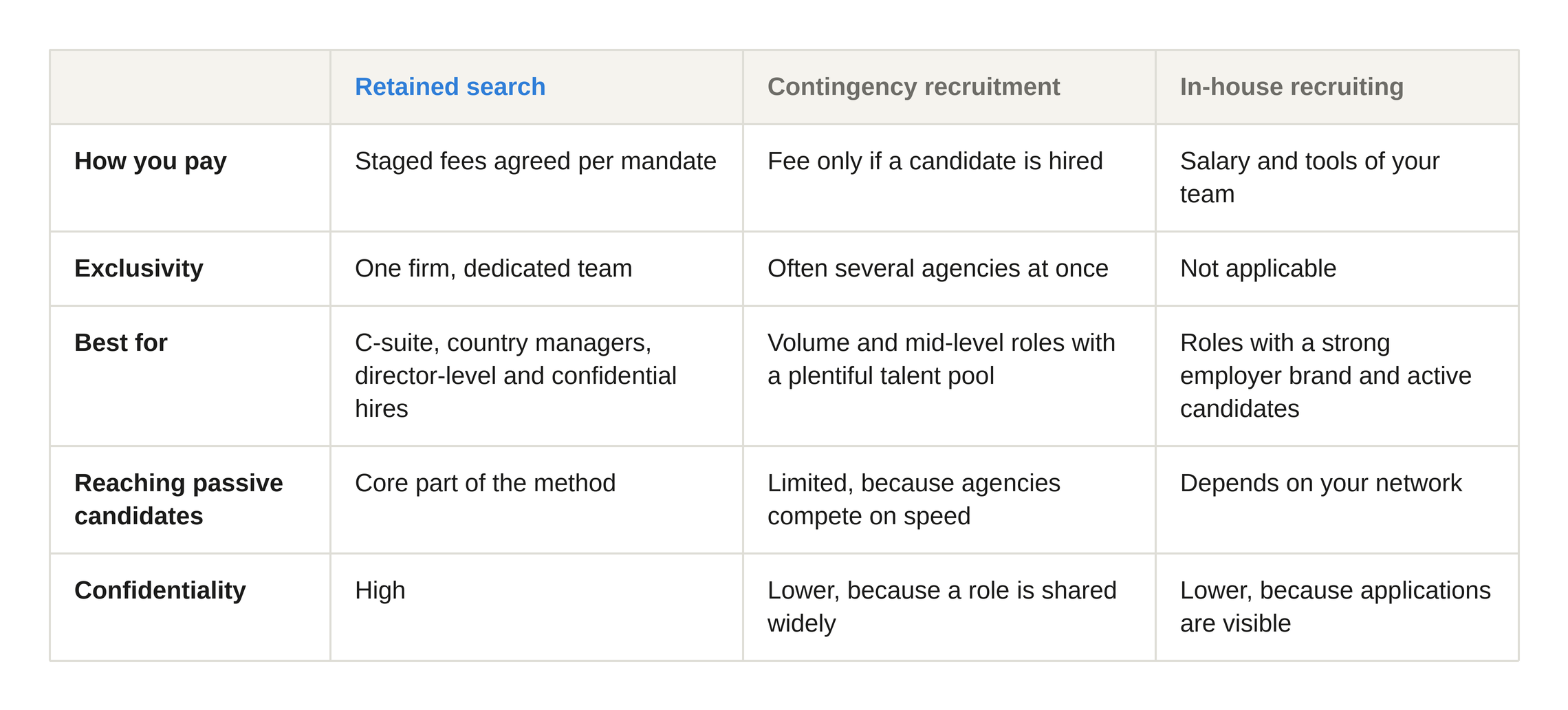
Retained search is an engagement in which a firm is hired exclusively for a specific senior role and is paid in stages, not only on a successful placement. The client commits to the search, and the firm commits a dedicated team to it. Contingency recruitment works the other way around: several agencies may work on the same role at the same time, and the client pays only if one of them places a candidate.
Retained fees are typically paid in instalments over the course of a search, and the model is generally preferred in Vietnam when confidentiality and seniority matter most.
Why Vietnam is a market where this matters
Three features of the Vietnamese market make a structured search more valuable than it might be elsewhere.
Investment is creating senior roles faster than the market can fill them. Vietnam's economy grew 9.01% in the first nine months of 2026, according to the National Statistics Office (NSO). Registered foreign investment reached US$50.36 billion in that period, up 76.4%, and disbursed FDI rose 12.1% to US$21.07 billion, the highest nine-month figure in five years. Each project needs leaders who can run it.
Skilled, experienced talent is scarce. The NSO reported that only about 29% of the workforce held a diploma or certificate in mid-2025. In specific fields the gap is wider: Vietnam has around 15,000 semiconductor specialists against a target of 50,000 by 2030, and a market report cited by VnEconomy put the IT sector's shortfall at about 200,000 people.
Senior pay is moving quickly. Michael Page's Vietnam Salary Guide 2026 reports annual increases of 9-12% for executive roles, with C-suite adjustments reaching 20-30% in some cases. NIC Global expects market-wide salary growth of 8-10% in 2026. A national salary average tells you little about what a particular leader will cost.
Seven things global companies get right
1. They treat a leadership hire as a strategic project
A country manager or finance director shapes the first three years of your presence in Vietnam. Companies that do this well define the mandate, reporting lines and success measures before approaching a single candidate, and they commit senior time to the search. A retained partner can challenge the brief early, which is cheaper than discovering a mismatch at the offer stage.
2. They go to passive candidates
The strongest executives are rarely on job boards. Reaching them takes systematic market mapping, that is, identifying every credible person in the target companies and functions, and a credible, discreet approach. HeadHunt Vietnam supports this with a database of more than 200,000 senior and specialist professionals and a dedicated team for each mandate.
3. They protect confidentiality
Replacing an incumbent, planning a succession or opening a new market often cannot be announced. A retained search runs quietly, without a public advertisement, which protects both your business and the people involved.
4. They benchmark compensation against the real market
With double-digit increases in scarce fields, last year's pay data is out of date. Experienced firms gather role-specific compensation information during the search, so you know what the market will bear before you make an offer. This is one reason the briefing stage matters.
5. They assess leadership fit, not only technical fit
Michael Page notes that companies are prioritising 'glocal' leaders, who can connect global or regional strategy with local regulatory and cultural understanding. Structured competency interviews and reference checks help test this before a candidate reaches you, and are standard in a retained process.
6. They plan for counter-offers and onboarding
Senior candidates are often counter-offered by their current employer. Firms that handle this well manage the offer stage actively, and support the first months after the hire starts. HeadHunt Vietnam includes counter-offer support and a 90-day onboarding follow-up in its retained process.
7. They choose a partner that is accountable
Look for clear timelines, regular written progress reports and a replacement guarantee. At HeadHunt Vietnam, retained searches are typically completed in 6-10 weeks, and we report progress in writing throughout.
What a retained search looks like, step by step
- Briefing and scoping. Agree the mandate, success criteria, reporting line, compensation range and timeline.
- Market mapping. Identify target companies and the full universe of potential candidates, including passive ones.
- Confidential outreach. Approach candidates discreetly and explain the opportunity.
- Assessment. Run structured competency interviews and reference checks.
- Shortlist and interviews. Present a short list of assessed candidates and coordinate your interviews.
- Offer and onboarding. Manage negotiation and counter-offers, then follow up through the first 90 days.
Throughout, you receive regular written reports and market intelligence, so you can see how the search is progressing.
As one example, an international bank's Singapore branch mandated HeadHunt Vietnam to replace its Chief Representative for Vietnam, Cambodia and Laos, based in Ho Chi Minh City. It is the kind of role where discretion, regional experience and fit matter more than speed alone.
When retained search is not the right tool
A retained search is built for senior, strategic or confidential roles. It is not the right tool for high-volume hiring, entry-level positions or roles with a large pool of active candidates. For those, flexible Staffing Solutions or a recruitment portal are usually a better fit. If you need cover while a permanent hire is found, Interim Management can place an experienced manager quickly.
How to choose a retained search firm in Vietnam
- Is it genuinely retained? Ask whether the firm commits a dedicated team to your role, or simply filters its existing database.
- Does it cover your sector? Look for placements and market knowledge in your industry.
- Is the process transparent? Ask about written reporting, timelines and the guarantee.
- Can it reach passive candidates? Ask how it maps the market and how large its network is.
- Does it understand multinationals? About 90% of HeadHunt Vietnam's clients are multinational companies, and the firm covers oil and gas and energy, FMCG and manufacturing, logistics and supply chain, technology and IT, finance and banking, and construction and real estate.
- Are the terms clear? Ask for a proposal that sets out fees, payment stages and what happens if a hire does not work out.
Talk to HeadHunt Vietnam
HeadHunt Vietnam has focused on retained mandates since 2012, has served more than 500 corporate clients and has completed more than 1,000 placements. If you are planning a leadership hire in Vietnam, we will start with a confidential briefing.
Request a confidential briefing or explore Retained Search and Executive Search. You can also reach us at info@headhuntvietnam.com or +84 981 707 253.
Frequently asked questions
What is a retained search firm? A firm hired exclusively, on a staged-fee basis, to find and assess candidates for a senior or confidential role, with a dedicated team assigned to the search.
What is the difference between retained and contingency search? In retained search, one firm is engaged exclusively and paid in stages. In contingency recruitment, several agencies may work on a role and the client pays only if a candidate is hired.
How long does a retained search take in Vietnam? At HeadHunt Vietnam, retained searches are typically completed in 6-10 weeks, depending on the seniority and complexity of the role.
When should a company use a retained search firm in Vietnam? For C-suite, country manager and director-level roles, confidential replacements, new-market leadership and any hire where reaching passive candidates matters.
How much does retained search cost? Fees vary by role and are agreed in a proposal, usually in stages. Ask for the fee structure, what each stage covers and what the replacement guarantee includes before you sign.
Sources
- NSO nine-month 2026 report, via Investment Monitor: https://www.investmentmonitor.ai/?p=130709
- FDI nine months 2026, via Viet Nam News: https://vietnamnews.vn/economy/1801241/nine-month-fdi-disbursement-hits-5-year-high.html
- NSO workforce data, via Vietnam Government News: https://en.baochinhphu.vn/viet-nams-working-age-population-accounts-for-almost-63-111260109111947185.htm
- Semiconductor workforce, via Viet Nam News: https://vietnamnews.vn/economy/1733010/viet-nam-s-semiconductor-surge-underscores-mounting-demand-for-skilled-workers.html
- IT workforce shortage, via VnEconomy: https://vneconomy.vn/vietnams-it-sector-faces-200-000-personnel-shortage.htm
- Michael Page Vietnam Salary Guide 2026, key findings: https://vn.linkedin.com/in/longnc/recent-activity/articles/
- NIC Global Vietnam Salary Guide 2026: https://nicvn.com/vietnam-salary-guide-2026-a-comprehensive-look-at-the-labor-market
- Retained and contingency models in Vietnam: https://www.careerlink.vn/cam-nang-viec-lam/tu-van-nghe-nghiep/headhunter-la-gi and https://aniday.com/en/blog/top-5-headhunter-services-in-vietnam-3425