Why Vietnam? A Career Guide for Senior Professionals
Vietnam combines record foreign investment, strong GDP growth and rising executive pay, creating senior career opportunities across technology, finance, manufacturing and logistics. This guide reviews 2026 salary…

本文目录
- 1. Growth creates senior roles
- 2. Pay is rising fastest where talent is scarce
- 3. Your pay goes further after the 2026 tax reform
- 4. Working here is easier for international professionals
- 5. Scope: regional and global mandates
- 6. Where to be based
- 7. The realities to weigh
- 8. How to make the move: five practical steps
- For employers: what senior candidates are weighing
- Frequently asked questions
- Sources
Why Vietnam Is a Great Place to Build a Career: A Guide for Senior Professionals
HeadHunt Vietnam | Retained Search and Executive Search in Vietnam since 2012
Why build a career in Vietnam? For senior professionals weighing a move, whether you are a Vietnamese leader considering a return, a regional executive looking for a bigger mandate, or an international manager exploring Southeast Asia, the answer comes down to three things: where the growth is, how far your pay goes, and how much scope the role gives you.
This guide looks at all three using official figures and published salary research as of October 2026, and is honest about the trade-offs. It is written for experienced professionals, and for the employers who want to hire them.
1. Growth creates senior roles
Senior opportunities follow investment, and Vietnam is attracting a lot of it. The economy grew by 8.02% in 2025, according to the National Statistics Office (NSO), and by 9.01% in the first nine months of 2026. Registered foreign direct investment reached US$50.36 billion in that period, up 76.4%, while disbursed FDI, money actually spent on factories, offices and operations, rose 12.1% to US$21.07 billion, the highest nine-month figure in five years.
Capital on that scale needs people to run it: country managers, plant directors, finance heads, commercial leaders and technology executives. Ho Chi Minh City led the country in newly registered FDI in the first nine months of 2026, with more than US$18.2 billion across 1,593 projects, which makes it the centre of gravity for senior hiring.
2. Pay is rising fastest where talent is scarce
Salary research points the same way. Michael Page's Vietnam Salary Guide 2026 reports the following trends:
- Technology and semiconductors: increments of 15-25% for specialists in AI, cloud and chip design.
- Executive roles: annual increases of 9-12%, with C-suite adjustments reaching 20-30% in some cases.
- Supply chain and procurement: growth of 7-12%.
- Finance and accounting: growth of 7-11%, with demand rising ahead of mandatory IFRS adoption.
NIC Global's Vietnam Salary Guide 2026 expects average salaries to rise by 8-10% across the market this year. Michael Page also observes that executive pay is closing the gap with regional hubs such as Malaysia and Thailand, so a senior role in Vietnam is increasingly a regional-grade career move rather than a discount version of one.
The shortages behind these numbers are real. Vietnam has around 15,000 semiconductor specialists against a national target of 50,000 by 2030, and a market report cited by VnEconomy estimated a shortfall of about 200,000 people in the IT sector. For experienced professionals, scarcity is leverage.
3. Your pay goes further after the 2026 tax reform
Personal income tax (PIT) rules improved for employees from the 2026 tax year. The personal deduction rose from VND 11 million to VND 15.5 million a month, the deduction per registered dependent rose from VND 4.4 million to VND 6.2 million, and the progressive schedule was simplified to five brackets (5%, 15%, 25%, 30% and 35% of taxable monthly income).
Government-published examples show the effect. A taxpayer with one dependent earning VND 50 million a month now pays about VND 1.84 million in PIT instead of about VND 4.3 million, and someone earning VND 100 million a month pays about VND 12.5 million, more than VND 5.5 million less than before.
There is also a targeted incentive for technology talent. Under the new Personal Income Tax Law (No. 109/2025/QH15, in force from 1 July 2026), qualified high-quality digital technology professionals and high-tech research and development staff can be exempt from PIT on salary income for five years. Eligibility is defined narrowly, by the Law on Digital Technology Industry, Decree 353/2025/ND-CP and the High Technology Law, so take tax advice before assuming a role qualifies.
4. Working here is easier for international professionals
Decree 219/2025/ND-CP, issued in August 2025, simplified the rules for foreign workers. The main changes for senior hires are:
- The two-step process (approval of labour demand, then the permit) is merged into a single application.
- The experience requirement for an 'expert' was reduced from three years to two, alongside a bachelor's degree.
- Foreign executives, experts and technicians can work in Vietnam for up to 90 days a calendar year without a work permit.
- A permit holder can work in different provinces for the same employer without a new permit.
- Foreign experts in priority fields such as finance, science and technology, innovation and digital transformation can qualify for exemptions when confirmed by the relevant authority.
Requirements still apply and details vary by case, so employers should confirm the position with their legal advisers. Foreign employees are also generally subject to health insurance on contracts of three months or more and social insurance on contracts of 12 months or more.
5. Scope: regional and global mandates
The quality of a role matters more than its location, and Vietnam increasingly offers mandates with real scope. Qualcomm's chief executive said in August 2026 that the company wants Vietnam to become its third-largest AI research and development hub worldwide, and Samsung has invested about US$24 billion in the country. Michael Page notes that companies are prioritising 'glocal' leaders, people who can connect regional or global strategy with local regulatory and cultural understanding. That is a good description of the strongest candidates for senior roles here.
Typical senior opportunities appear in the sectors where foreign investment is concentrated: manufacturing and FMCG, technology and IT, logistics and supply chain, banking and finance, energy, and construction and real estate.
6. Where to be based
Vietnam has two main career hubs. Ho Chi Minh City is the commercial and financial centre, with local GDP growth of 9.06% in the first nine months of 2026, while Hanoi (8.85%) combines government, regulatory and R&D roles, and hosts established technology centres. Choose by sector and by who your customers, regulators and teams are.
7. The realities to weigh
A balanced decision considers the trade-offs.
- A skills-constrained market. Only about 29% of the workforce held a diploma or certificate in mid-2025 (NSO), so senior leaders spend more time on coaching and capability-building than they might elsewhere.
- External exposure. Vietnam is export-oriented. The NSO reported a goods trade deficit of US$19.42 billion in the first nine months of 2026, so global demand and trade policy can affect employers.
- Competition for jobs at the top. The best roles are filled quietly, often through search firms, and not advertised.
- Tax and legal details. Residency, allowances and incentives depend on your circumstances, so get personal advice.
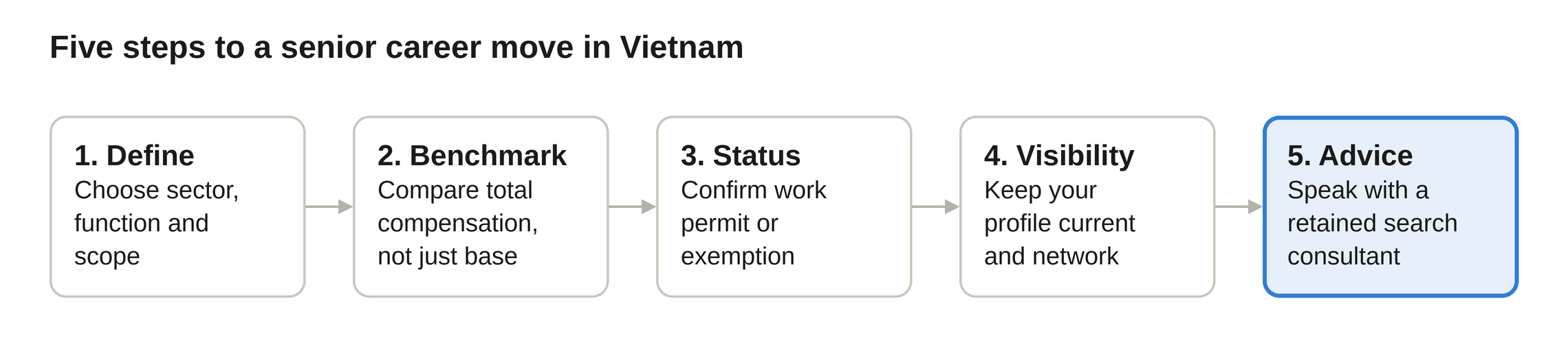
8. How to make the move: five practical steps
- Define your target. Choose the sector, function and level of scope you want, not just the city.
- Benchmark your package. Use role-specific data and remember to look at total compensation, not just base salary.
- Check your status. International professionals should confirm work permit or exemption options with the prospective employer before resigning.
- Build your visibility. Keep your profile current and talk to specialist recruiters in your sector, since many senior roles are never advertised.
- Talk to a retained search consultant. A consultant who covers your sector can explain how employers think, which roles are coming and what the market will pay.
For employers: what senior candidates are weighing
The strongest candidates are rarely looking, and they compare your offer with what they already have, in scope, growth, package and culture. Employers who win them usually do four things well: explain the mandate clearly, benchmark compensation against the real market, manage counter-offers, and support the first months of onboarding.
That is the work of a retained search. HeadHunt Vietnam has focused on retained mandates since 2012, mostly for multinational clients, and covers sectors including oil and gas and energy, FMCG and manufacturing, logistics and supply chain, technology and IT, finance and banking, and construction and real estate. A dedicated team handles market mapping, discreet outreach to passive candidates, structured assessment, offer management and counter-offer support, and 60-day onboarding follow-up, with searches typically completed in 6-10 weeks and a replacement guarantee.
Hiring a senior leader in Vietnam? Request a confidential briefing or explore Executive Search.
A senior professional exploring opportunities in Vietnam? Get in touch at info@headhuntvietnam.com or +84 981 707 253 for a confidential conversation.
Frequently asked questions
Is Vietnam a good place to build a senior career? For many professionals, yes. The economy grew 9.01% in the first nine months of 2026, foreign investment is at record levels, and demand for experienced leaders is outpacing supply, which pushes pay and responsibility up.
How fast are executive salaries rising in Vietnam? Michael Page's 2026 guide reports annual increases of 9-12% for executives, with C-suite adjustments reaching 20-30% in some cases, and 15-25% for specialists in AI, cloud and chip design.
Can foreigners work in Vietnam as executives? Yes, with a work permit or a qualifying exemption. Decree 219/2025/ND-CP simplified the process, merged the application steps and allows up to 90 days of work a year without a permit. Details depend on the role, so the employer should confirm the position.
Did personal income tax fall in 2026? For most salaried employees, yes. The personal deduction rose to VND 15.5 million a month, the dependent deduction to VND 6.2 million, and the brackets were reduced from seven to five.
Which sectors hire the most senior talent? Manufacturing, technology and IT, logistics and supply chain, finance and banking, and energy are among the sectors attracting the most foreign investment and the highest salary growth.
Sources
- NSO 2025 GDP, via Viet Nam News: https://asianews.network/vietnam-records-8-02-gdp-growth-in-2025-8-46-in-q4/
- NSO nine-month 2026 report, via Investment Monitor: https://www.investmentmonitor.ai/?p=130709
- FDI nine months 2026, via Viet Nam News and VietnamNet: https://vietnamnews.vn/economy/1801241/nine-month-fdi-disbursement-hits-5-year-high.html and https://vietnamnet.vn/en/foreign-investment-in-vietnam-tops-50-billion-singapore-leads-inflows-2561450.html
- Michael Page Vietnam Salary Guide 2026, key findings: https://vn.linkedin.com/in/longnc/recent-activity/articles/
- NIC Global Vietnam Salary Guide 2026: https://nicvn.com/vietnam-salary-guide-2026-a-comprehensive-look-at-the-labor-market
- Semiconductor workforce, via Viet Nam News: https://vietnamnews.vn/economy/1733010/viet-nam-s-semiconductor-surge-underscores-mounting-demand-for-skilled-workers.html
- IT workforce shortage, via VnEconomy: https://vneconomy.vn/vietnams-it-sector-faces-200-000-personnel-shortage.htm
- Personal income tax reform examples, via Viet Nam News: https://vietnamnews.vn/economy/1732735/millions-set-to-benefit-from-personal-income-tax-reduction-from-2026.html
- PIT brackets, deductions and incentives: https://www.vietnam-briefing.com/doing-business-guide/vietnam/taxation-and-accounting/individual-income-tax, https://vialtopartners.com/regional-alerts/vietnam-employment-tax-draft-decree-on-new-personal-income-tax-pit-law and https://assets.kpmg.com/content/dam/kpmg/vn/pdf/2026/01/new-pit-law-en.pdf
- Foreign worker rules, Decree 219/2025/ND-CP: https://www.tilleke.com/insights/vietnam-relaxes-requirements-for-foreign-workers/ and https://blogs.duanemorris.com/vietnam/2025/09/03/vietnam-decree-219-regulating-foreign-workers-in-vietnam-what-you-must-know/
- Qualcomm and Samsung, via The Star: https://www.thestar.com.my/tech/tech-news/2026/08/28/vietnam-urges-qualcomm-samsung-to-deepen-ai-chip-investment-as-it-seeks-tech-upgrade
- Ho Chi Minh City FDI, via VietnamNet: https://vietnamnet.vn/en/ho-chi-minh-city-becomes-asia-s-tech-fdi-magnet-with-6-6-bln-usd-inflow-2522842.html
- NSO workforce and employment data, via Vietnam Government News: https://en.baochinhphu.vn/viet-nams-working-age-population-accounts-for-almost-63-111260109111947185.htm