Why Vietnam for Tech and IT? How to Build an Engineering Team in Southeast Asia
Vietnam's digital technology industry reached an estimated US$198 billion in 2025, with major investment from Samsung, Qualcomm and semiconductor and AI projects. This guide explains why Vietnam is a serious location…

Nội dung bài
- 1. A digital economy growing faster than most of the region
- 2. Global technology players are already investing
- 3. A growing pipeline of engineering talent
- 4. Modern digital infrastructure and strong policy backing
- 5. A convenient time zone and two established tech hubs
- What to plan for before you build
- How to build your Vietnam tech team
- Why a retained approach works for technology leaders
- Frequently asked questions
- Sources
Why Vietnam for Tech and IT? How to Build an Engineering Team in Southeast Asia
HeadHunt Vietnam | Retained Search and Executive Search in Vietnam since 2012
Why Vietnam for tech and IT? A decade ago the answer was mostly cost. Today it is about scale, momentum and a fast-growing base of engineers working alongside global technology companies. Vietnam's digital technology industry is now large enough to matter on a global map, and the companies investing in semiconductors, AI and data infrastructure are building teams here right now.
This guide explains what makes Vietnam a serious option for engineering, R&D and technology operations, which challenges to plan for, and why the first leadership hire often decides how well the rest of your team performs. All figures are the latest available official or reported data as of October 2026.
1. A digital economy growing faster than most of the region
According to the Ministry of Science and Technology, Vietnam's digital technology industry earned an estimated US$198 billion in revenue in 2025, up 26% on the previous year and 16% above the annual target. Digital technology exports were estimated at about US$172 billion, and the country has around 80,000 digital technology enterprises. E-commerce revenue reached roughly US$36 billion, and the digital economy's gross merchandise value was about US$39 billion, growing 17%, the second-fastest rate in Southeast Asia.
The National Statistics Office (NSO) estimates that the digital economy contributed about 14.02% of GDP in 2025, up from 12.87% in 2021.
One point of context matters for anyone planning a software or R&D team. The NSO's core digital sectors include electronics manufacturing and telecommunications as well as computer programming and data processing, so a large share of the headline revenue comes from hardware. Vietnam's own minister of science and technology has also noted that the digital economy is still largely about digitising existing processes, with limited local value creation and reliance on foreign platforms. For a foreign company, that is both a caution and an opportunity: there is room for higher-value engineering work.
2. Global technology players are already investing
Vietnam is no longer an experiment for the technology industry. Samsung has invested about US$24 billion in the country, according to a government statement reported in August 2026. In the same month, Qualcomm's chief executive told Vietnamese leaders the company wants to grow its Vietnam operation into its third-largest AI research and development hub worldwide, building on its existing R&D centre in Hanoi.
Investment is shifting toward higher-value activities. Ho Chi Minh City has been attracting a cluster of high-tech projects in semiconductors, AI, data centres and R&D in 2026. Two hyperscale data centres worth nearly US$1 billion in total are in the pipeline, and a US$2.1 billion AI data centre project was announced in March 2026 at the Tan Phu Trung Industrial Park. In April 2026, four high-tech projects in the Saigon Hi-Tech Park, with combined capital above US$1.23 billion, received investment certificates.
At the national level, the Foreign Investment Agency reported US$24.81 billion in registered FDI in the first five months of 2026, up 34.9% year on year, with technology-related sectors prominent among new projects.
3. A growing pipeline of engineering talent
Vietnam's demographic profile is a core advantage: about 62.7% of its 102.3 million people were of working age in 2025 (NSO). Reported figures put the number of IT graduates produced by universities and colleges at roughly 50,000 each year, though headcount estimates for the existing IT workforce vary widely by source, so treat any single number with care.
The semiconductor segment shows both the opportunity and the gap. Vietnam currently has around 15,000 semiconductor specialists against a national target of 50,000 by 2030, according to reporting in January 2026 that cites a World Bank study. The most acute shortage is full-stack chip engineers who can handle design from concept to commercialisation. Employers who start building teams now will have an advantage over those who wait.
4. Modern digital infrastructure and strong policy backing
Vietnam's Deputy Prime Minister reported in December 2025 that 5G networks cover about 90% of the population and that the country's mobile internet speeds ranked in the global top 20 in 2025. Government messaging is consistent: leaders describe a growth model driven by science, technology, innovation, digital transformation and AI, and have publicly asked global technology companies to expand their investment.
For employers, this means stable political support for the sector and a pipeline of public programmes aimed at training more engineers.
5. A convenient time zone and two established tech hubs
Vietnam is on UTC+7, which gives engineering teams a workable overlap with Singapore, Japan, Korea, Australia and much of Asia-Pacific, as well as early-morning or evening overlap with Europe. Ho Chi Minh City and Hanoi are the two main hubs, so companies can choose between the commercial and financial centre of the south and the government and R&D centre of the north.
What to plan for before you build
A credible 'Why Vietnam' case for tech also looks at the risks.
- Competition for experienced engineers. A market report cited by VnEconomy in May 2025 estimated that the IT sector would need about 700,000 new people by 2025 while domestic institutions could supply about 500,000, leaving a gap of around 200,000.
- Graduate readiness. The same report quotes an academic saying that only about 30% of the roughly 50,000 annual IT students are immediately employable, with most needing further training. Plan for onboarding and mentoring.
- Scarce senior leadership. The hardest roles to fill are rarely junior developers. They are the CTOs, engineering heads, data and AI leaders and country managers who can turn a team into a business. Those people are usually employed, well paid and not browsing job boards.
- Evolving regulation. Data, AI and technology rules are developing quickly, so get local legal and tax advice before finalising your structure.
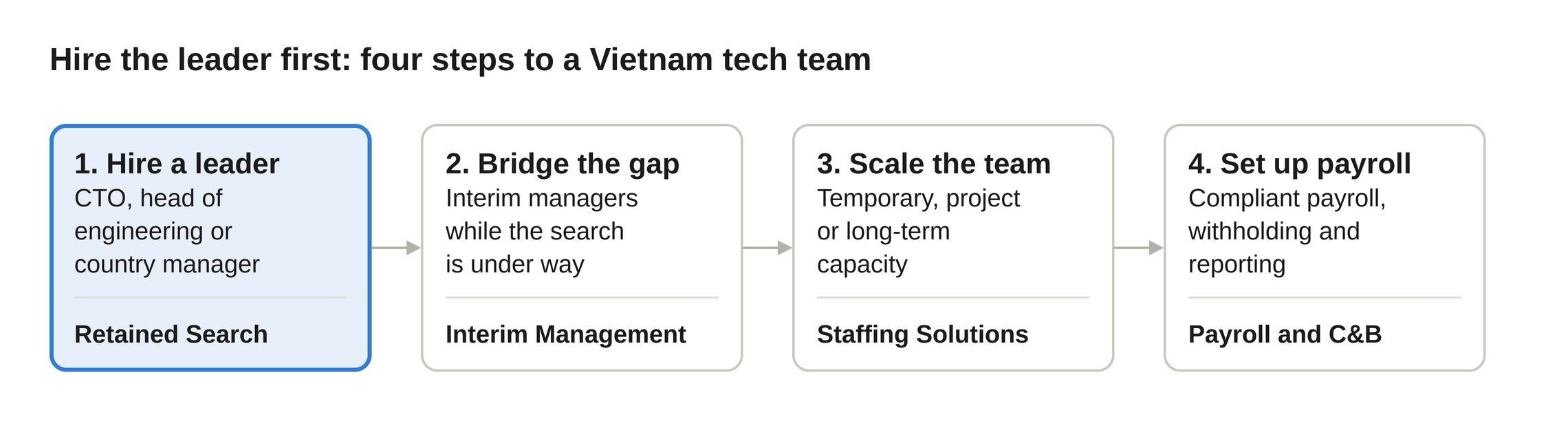
How to build your Vietnam tech team
Companies that succeed tend to follow a simple sequence.
- Hire the leader first. A strong local CTO, head of engineering or country manager brings the network, hiring credibility and cultural fluency that make every later hire faster. This is where Retained Search and Executive Search add the most value, because a dedicated team can map the market and approach passive candidates discreetly.
- Bridge gaps with interim leadership. If you need someone in place while the permanent search runs, Interim Management can provide experienced managers and specialists immediately.
- Scale with flexible staffing. For project-based or fast-growing needs, Staffing Solutions provide temporary, project or long-term capacity.
- Get payroll right from day one. Compliant payroll, withholding and reporting across Vietnamese locations is easier with a managed Payroll and C&B service.
Roles that typically anchor a Vietnam technology presence include Chief Technology Officer, VP or Head of Engineering, Head of Data and AI, IT Director, Head of Product, cybersecurity leadership, and country or general managers for technology businesses.
Why a retained approach works for technology leaders
Technology leaders are among the most contacted professionals in the market, yet the strongest are rarely looking. HeadHunt Vietnam has worked exclusively on retained mandates since 2012, with about 90% of clients being multinational companies. In practice that means a dedicated team for your search, systematic mapping of the target market, discreet outreach to passive candidates, structured competency interviews and reference checks, regular written progress reports, and a replacement guarantee. Searches are typically completed in 6-10 weeks, supported by a database of more than 200,000 senior and specialist professionals. Technology and IT is one of the sectors we cover.
Planning to build or expand a technology team in Vietnam? Request a confidential briefing and we will outline how a retained search for your technology leadership would work. You can also reach us at info@headhuntvietnam.com or +84 981 707 253.
Frequently asked questions
Why is Vietnam a good location for IT and engineering teams? Because it combines a large and young working-age population, a digital technology industry earning an estimated US$198 billion in 2025, active investment from global technology companies, and policy support for AI, semiconductors and digital infrastructure.
How many IT graduates does Vietnam produce each year? Reported figures are roughly 50,000 IT graduates a year. Estimates of how many are immediately job-ready are much lower, so employers should budget for training.
Is there a shortage of tech talent in Vietnam? Yes, particularly for experienced and senior roles and for specialised fields such as semiconductors, where Vietnam has about 15,000 specialists against a 2030 target of 50,000.
Which cities are best for a tech team in Vietnam? Ho Chi Minh City and Hanoi are the two main hubs. Ho Chi Minh City has been attracting a wave of data centre, AI and semiconductor investment in 2026, while Hanoi hosts established R&D centres such as Qualcomm's.
How long does it take to hire a CTO or head of engineering in Vietnam? At HeadHunt Vietnam, retained searches typically take 6-10 weeks, depending on the seniority and complexity of the role.
Sources
- Ministry of Science and Technology, via Viet Nam News: digital technology industry 2025 results, https://vietnamnews.vn/economy/1733105/digital-technology-industry-surpasses-2025-targets.html
- Ministry of Science and Technology, via VnEconomy: enterprises and exports, https://en.vneconomy.vn/vietnams-2025-digital-economic-revenue-estimated-at-198-billion.htm
- Deputy Prime Minister remarks, via Tuoi Tre News: digital exports, 5G coverage, https://news.tuoitre.vn/vietnams-digital-technology-exports-hit-172bn-in-2025-103251231111204888.htm
- National Statistics Office, via VnEconomy: digital economy share of GDP, https://en.vneconomy.vn/digital-economy-contributes-1402-to-vietnams-gdp.htm
- Reuters, via The Star: Qualcomm and Samsung, August 2026, https://www.thestar.com.my/tech/tech-news/2026/08/28/vietnam-urges-qualcomm-samsung-to-deepen-ai-chip-investment-as-it-seeks-tech-upgrade
- Viet Nam News: Ho Chi Minh City tech FDI, https://vietnamnews.vn/economy/1782820/hcm-city-becomes-asia-s-tech-fdi-magnet-with-6-6b-inflow.html
- VnEconomy: high-tech FDI, June 2026, https://en.vneconomy.vn/high-tech-fdi-wave-strengthens-vietnams-position-in-digital-economy.htm
- Viet Nam News: semiconductor workforce, January 2026, https://vietnamnews.vn/economy/1733010/viet-nam-s-semiconductor-surge-underscores-mounting-demand-for-skilled-workers.html
- VnEconomy: IT workforce shortage, May 2025, https://vneconomy.vn/vietnams-it-sector-faces-200-000-personnel-shortage.htm
- National Statistics Office, via Vietnam Government News: population structure, https://en.baochinhphu.vn/viet-nams-working-age-population-accounts-for-almost-63-111260109111947185.htm